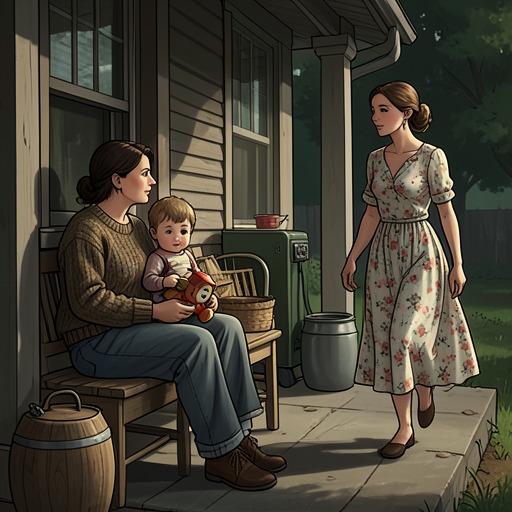
Catalina admits she loves a woman and ends the marriage
La uruguayaCatalina’s admission that she loves a woman makes the couple’s separation explicit and overturns Lucas Pereyra’s assumptions about their marriage. Recalled by Lucas after the fact, the conversation moves from an account of his own attachment to Magalí Guerra to Catalina’s disclosure of a relationship she has carried for nearly a year. Its consequences extend beyond the end of the marriage: Lucas must confront his shock and hurt while considering a new, shared family life for Maiko.
Background and the conversation
The disclosure comes after Lucas and Catalina return from a night in the hospital, where Lucas has been treated following the assault that left his rib fractured. Catalina tells him that Maiko will sleep at her mother’s house, then asks what they are going to do. They cannot go on as they have, she says; they need to discuss what each of them wants. The domestic detail and the direct question make the separation a decision to face, not merely an unspoken strain.
Lucas recounts that Catalina asks who Magalí Guerra is, and he tells her. He senses that she is somewhat disappointed, as if his distant infatuation is not the fuller revelation she needs in order to speak about her own life. In his later telling, he understands her question as a possible opening for her confession, though that interpretation remains his. The exchange is not a simple contest of disclosures: his account of Guerra gives way to a truth he had not anticipated.
Catalina’s disclosure
Catalina tells Lucas that she is in love with a woman, a friend. She is unsure whether the word lesbian describes her, but says that she loves this particular woman. The woman is a doctor who works at Trinidad; they met at a Fundación Cardio Life cocktail on a terrace. They have exchanged emails and WhatsApp messages, seen one another, and smoked marijuana at the doctor’s home. Catalina says they have loved each other for nearly a year and that she will no longer hide the relationship.
The duration and specificity of the account distinguish it from a passing attraction. Catalina names a bond already sustained through messages, meetings, and time, while also refusing to claim an identity she is unsure of. Her decision not to conceal the relationship marks a change in the terms of the marriage: what had remained private is now being stated as a reason they cannot continue as before.
Lucas’s shock and its aftermath
Lucas recalls being almost catatonic. Walking along Avenida Santa Fe among closed clothing shops, he had expected Catalina to be seeing a male doctor from the foundation; the possibility of a woman had not entered his calculations. The revelation leaves him feeling alternately cold and hot, with his head pounding and the sense that he might faint. His physical disorientation registers how completely the news breaks with the story he had prepared himself to believe.
He also remembers the disclosure’s wider reverberations. Catalina’s mother calls him, and at first he does not know what to say. Her father does not speak to her for two months; the news shocks her cousins and their friends. Lucas says that people initially take his side and later begin to understand. He is left sexually wounded, but says he feels neither hatred nor anger. His account therefore distinguishes the pain of being left and the injury to his sense of himself from a wish to punish Catalina.
Separation and a changed family
Lucas’s later response is not to insist that Maiko’s family remain organized around the marriage. He says he has no objection to Maiko living with Catalina and her partner on the weekdays when Maiko is not with him, and that he wants to meet the partner. He imagines inviting the two of them to his home so Maiko can see all three adults together, without nervousness or silence. He is even open to shared outings and perhaps holidays, while acknowledging that a holiday in the same resort may be as much as they can manage.
This is a proposal for a family arrangement, not proof that every part of it has already been put into practice. Lucas’s language allows for uncertainty, but its direction is clear: Maiko’s family has become something other than the household formed by the marriage. He describes it as made of combinable blocks, assembled as each person can. The conversation thus ends one marital structure while opening the possibility of a cooperative one, in which Catalina’s partner is not automatically treated as an enemy or kept outside Maiko’s life.
Narrative significance
The event is presented through Lucas’s retrospective account, so Catalina’s words and actions reach the reader through the perspective of the husband who is being left. That perspective keeps his hurt visible while also exposing the limits of his certainty: he had assigned Catalina a male lover and is stunned when the truth does not fit. His admission that he is still processing the news prevents the later willingness to meet her partner from being mistaken for an absence of pain.
The conversation also shifts the meaning of separation from private rupture toward a practical redefinition of kinship. Lucas’s response remains unfinished and cautious, but he can imagine Maiko seeing his mother, her partner, and him together. The decisive change is not that the marriage ends without injury; it is that Lucas begins to separate the end of the marriage from the continued responsibilities and possible forms of care that bind the family.